
A Journey Through Singapore’s Religions

A Journey Through Singapore’s Religions

Singapore is a cosmopolitan city-state boasting a unique blend of cultures and traditions from all across the world. One of the most intriguing aspects of Singapore’s cultural tapestry is its vibrant mix of Buddhism, Hinduism, Islam, Christianity, and other faiths, offering a glimpse into Southeast Asia’s rich and varied practices. Whether you’re a believer or not, exploring these sites is a must-do experience that will leave you awestruck and enlightened. 

Major religions in Singapore


1.Buddhism

Buddhism is a significant religion in Singapore, with 31.1% of the citizen and permanent resident population being Buddhist, according to the 2020 census data. Religion emphasizes values such as mindfulness, compassion, and non-attachment.

Buddha Tooth Relic Temple and Museum
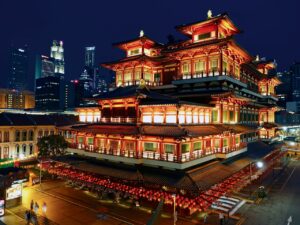
It houses what is believed to be Lord Buddha’s left canine tooth in a solid gold stupa on the fourth floor. The temple’s design replicates the Tang Dynasty and Buddhist Mandala styles. On the third floor, you can find the Buddhist Cultural Museum and the Eminent Sangha Museum. The rooftop garden has the world’s largest Buddhist prayer wheel and a pagoda.

Best time to visit: During Buddhist festivals such as Vesak Day

                        Click here to know more

Insider Tip: Free guided tours are available on Saturdays in Mandarin and English. These tours offer insights into Buddhist culture, Singaporean heritage, Chinese culture, Chinatown’s history, and Buddhist philosophy, conducted by specially trained guides. Visitors can also attend blessings and prayer sessions and enjoy free vegetarian meals and desserts at the basement and Five Insights Hall, respectively.

2. Islam

Islam is the second-largest religion in Singapore, with 15.6% of the citizen and permanent resident population being Muslim, predominantly Sunni, as per 2020 census data. The religion’s teachings emphasize the values of charity, community, and the oneness of God.

Sultan Mosque  
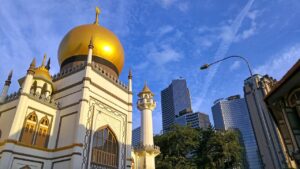
Singapore’s largest mosque, the Sultan Mosque, is a must-visit in the historic Kampong Glam district. Built in 1824 for the first Sultan of Singapore with the help of Sir Raffles, it was gazetted as a National Monument in 1975. Its Indo-Saracenic style, highlighted by a shimmering golden dome, makes for an enchanting appearance. The mosque serves as a reminder of Malay royalty and the Muslim community’s culture and diversity in Singapore. Remember, the mosque remains closed for prayers.

Best time to visit: During Islamic festivals such as Ramadan and Hari Raya Puasa

Click here to know more

Insider Tip: For a seamless visit to the Sultan Mosque, it’s crucial to adhere to the dress code. If you forget to dress suitably, robes are available at the entrance on a first-come, first-served basis. And before entering, remember to take off your shoes.

3. Hinduism

Based on the 2020 census data, Hinduism has a significant number of followers in Singapore, with 5 percent of the country’s citizens and permanent residents identifying as Hindu. Hinduism is among the most ancient religions globally and teaches the significance of devotion and ritual, along with the interdependence of all beings.

Sri Mariamman Temple
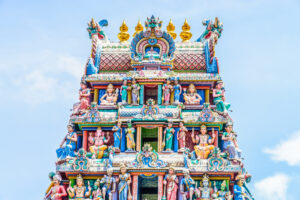
Sri Mariamman Temple, Singapore’s oldest temple, sits in Chinatown and is dedicated to the Hindu goddess Mariamman, renowned for healing illnesses and epidemics. The temple dates back to 1827 and is adorned with intricate plasterwork images of Hindu deities on the six-tiered gopuram above the entrance. The temple’s sacred cow sculptures and architectural beauty make it popular among architecture enthusiasts and tourists alike. The Sri Mahamariamman Temple is a Singaporean National Monument and has served as a Registry of Marriages for Hindu couples and as a refuge for immigrants. The Thimithi, a fire-walking ceremony held a week before Diwali, is a notable event celebrated at the temple.

Best time to visit: During Hindu festivals such as Deepavali

 Click here to know more

Insider Tip: Consider visiting temples early in the morning or after sunset. During midday, many visitors will swarm the temples. Besides, remember you will walk around without shoes on sunny days.

4. Christianity

As represented by various denominations, Christianity has a significant 18.9 percent of Singapore’s population as practitioners, according to the 2020 census. Its teachings emphasize love, forgiveness, and salvation. 

St. Andrew’s Cathedral
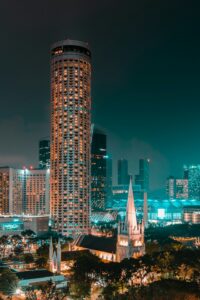
Standing tall in Singapore’s Civic District, St Andrew’s Cathedral is a beautiful Neo-Gothic architectural masterpiece, made of white-stone walls with intricate embellishments, pointed windows, and a spire touching the sky. The cathedral features colorful stained-glass windows dedicated to the significant historical figures of John Crawford, William Butterworth, and Stamford Raffles. 

Best time to visit: Christmas

                         Click here to know more

Insider Tip: A religious person or not, do sit through the Sunday church services and listen to the beautiful choir of St. Andrew’s Cathedral.

5. Taoism
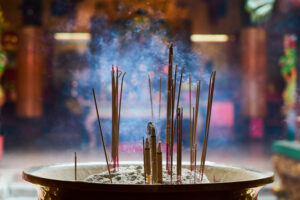
Taoism, an ancient Chinese philosophy and religion practiced for thousands of years, has significantly influenced the country’s culture and traditions.  As of the 2020 census, 8.8 percent of the country’s citizens and permanent residents identified as Taoists.

Thian Hock Keng Temple

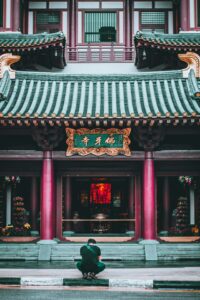
This is Chinatown’s oldest Hokkien temple, built between 1839 and 1842 to worship Mazu, a Chinese sea goddess. The temple’s symbolic designs include stone lions guarding the entrance with phoenixes and peony paintings representing peace and good tidings. The temple has traditional Chinese architectural elements, including porcelain pieces on the roof and dragon and deity sculptures. 

Best time to visit: During Chinese New Year, the most important festival celebrated by Taoists and other Chinese communities worldwide.

                        Click here to know more

Insider Tip: Many religious sites have statues and idols that are considered sacred. Avoid touching or leaning on them, and don’t take selfies.

Other Religions in Singapore
In addition to the major religions in Singapore, several smaller religious groups have smaller followings. These groups comprise less than 1 percent of the population, including Sikhs, Zoroastrians, Jains, Jews, Jehovah’s Witnesses, and members of the Family Federation for World Peace and Unification (Unification Church). 

  1. The Jain Temple, located in the Yishun neighborhood, is the only Jain temple in Singapore and is known for its beautiful marble carvings. 
  2. The Sikh community has its Gurdwara Sahib in the Serangoon neighborhood, where you are welcome to learn more about the Sikh faith. 
  3. Similarly, the Zoroastrian community has a fire temple called the Zoroastrian Association of Singapore in the Queenstown neighborhood.

Exploring the religious places in Singapore can provide you with a unique insight into the country’s rich history, culture, and diversity. From stunning temples and mosques to beautiful churches and gurdwaras, there is something for everyone to explore and appreciate.

FAQS

Some of Singapore’s most well-known religious places include the Buddha Tooth Relic Temple, Sri Mariamman Temple, Masjid Sultan Mosque, Thian Hock Keng Temple, and St. Andrew's Cathedral.
Religion is an integral part of Singaporean culture, with Buddhism, Christianity, Islam, Hinduism, and Taoism being the major religions in the country. It gives individuals and communities a sense of identity and belonging and shapes social and cultural values.
Religious places in Singapore have evolved over the years to reflect the changing needs and aspirations of the communities they serve. Many of them have undergone renovation or expansion to accommodate growing congregations. Also, a recent trend is observed toward utilizing modern technology to improve the worship experience.
Singapore is known for its religious harmony. The government has implemented policies promoting mutual understanding and respect among diverse religious communities. Interfaith dialogue and cooperation are actively encouraged, and religious leaders are often involved in community outreach programs.
Religious places in Singapore are major tourist attractions, with many tourists visiting to see these sites’ architectural beauty and cultural significance. They also provide opportunities for visitors to learn about different religions and cultures.
A wide range of religious practices and rituals can be observed in Singapore, including prayer, meditation, offerings, pilgrimage, and festivals. These practices often vary based on the specific religion and its traditions.
Religious places in Singapore often provide a range of services to support the local community, including education, healthcare, and welfare programs. They also support the elderly, disadvantaged, and marginalized groups.
Religious places in Singapore play a crucial role in promoting social cohesion and harmony by providing a space for interfaith dialogue and cooperation. They also often work with other religious and secular organizations to address social issues and promote peace.
Religious places in Singapore often provide educational programs and resources for individuals and the wider community, including language classes, cultural events, and religious studies. They may also engage in public outreach activities to promote understanding and awareness of different religions and cultures.
Religious places in Singapore feature a range of architectural styles and art forms, reflecting the country’s diverse cultural and religious traditions. These can include intricate carvings, colorful murals, ornate sculptures, and traditional and modern architectural designs.
Religious places in Singapore actively work to counter the influence of extremist ideologies through education, interfaith dialogue, and community outreach. They also cooperate with government agencies to monitor and prevent the spread of extremist ideas.
Religious places in Singapore promote interfaith dialogue and understanding through activities like joint worship services, forums, and cultural events. They also collaborate with other religious and secular organizations to promote mutual respect and understanding.
Buddhist temples in Singapore serve as places of worship, community gathering, and centers for Buddhist education and meditation. They also play a role in preserving and promoting Buddhist culture and traditions.
Hindu temples in Singapore celebrate various religious festivals and traditions throughout the year, including Diwali, Thaipusam, and Navaratri. These celebrations often involve elaborate rituals, offerings, and processions.
Mosques in Singapore serve as places of worship, education, and community gathering for Muslims. They also promote Islamic values and teachings through numerous activities like Quranic classes, religious talks, and community outreach programs.
Churches in Singapore play a crucial role in the country's Christian community, providing places of worship, community gathering, and Christian education. They also engage in various outreach activities to serve the wider community.
Taoist temples in Singapore serve as places of worship and community gathering for followers of Taoism. They also play a role in preserving and promoting Taoist culture and traditions.
Religious places in Singapore often cater to the needs of different religious communities by providing services such as worship, education, and welfare programs. They may also offer resources and support for individuals seeking to learn more about different religions.
Religious places in Singapore often promote volunteerism and community service by providing opportunities to get involved in charitable activities and community outreach programs. They may also collaborate with other religious and secular organizations to address social issues.
Religious places in Singapore often handle the issue of religious diversity within their community through the promotion of mutual respect and understanding. They may also engage in activities such as interfaith dialogue and education to address any misunderstandings or conflicts.
Religious places in Singapore have increasingly recognized their role in promoting environmental sustainability and have implemented various eco-friendly initiatives, such as recycling, energy conservation, and using sustainable materials. They also educate their followers on environmental issues and encourage sustainable practices.
Religious places in Singapore have varying attitudes towards gender and sexual orientation. While some have more conservative views, others actively promote inclusivity and support the LGBTQ+ community. Some religious places also provide counseling and support services for individuals struggling with gender or sexual identity issues.
Religious places in Singapore often provide healthcare and social welfare services to their communities, such as free medical clinics, eldercare services, and counseling services. They may also collaborate with government agencies and other organizations to address social issues.
Religious places in Singapore often play a significant role in preserving the country's cultural heritage, particularly in architecture, art, and traditional practices. They may organize cultural events, festivals, and workshops to promote awareness and appreciation of cultural heritage.
Singapore’s spiritual retreats and meditation centers provide individuals with a space for reflection, contemplation, and spiritual growth. They offer various programs and activities, such as meditation, yoga, and spiritual workshops, to help individuals develop a profound sense of inner peace and fulfillment.
Religious places in Singapore often provide counseling and support services for individuals struggling with mental health issues. They may also collaborate with mental health professionals and organizations to raise awareness and provide resources for those in need.
Religious places in Singapore often play a significant role in philanthropic activities, such as providing disaster relief, supporting social causes, and promoting community service. They may also organize fundraising events and encourage their followers to contribute to charitable causes.
The future of religious places in Singapore will likely involve greater collaboration, interfaith dialogue, and a stronger emphasis on sustainability, inclusivity, and community outreach. They may also continue to evolve and adapt to changing social and cultural trends.
Individuals can support and contribute to the sustainability and vitality of religious places in Singapore by participating in their activities, volunteering their time and resources, and promoting their causes to others. They can also support eco-friendly initiatives and practices and advocate for inclusivity and diversity within religious communities.
Religious places in Singapore promote the country's image as a tolerant and inclusive society through their active efforts to promote interfaith dialogue, social outreach, and inclusivity. They also collaborate with government agencies and other organizations to address social issues and promote harmony.

Lorem ipsum dolor sit amet, consectetur adipiscing elit. Ut elit tellus, luctus nec ullamcorper mattis, pulvinar dapibus leo.

Share :

Comments

Scroll to Top